
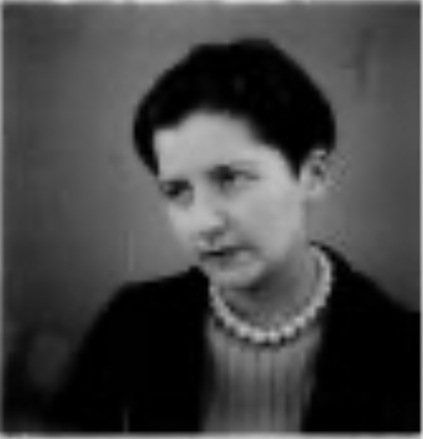
Three personalities: Louis Charles Damais, Claire Holt, Étiennette Bénichou
Étiennette Bénichou, the activist
I first heard about Bénichou when I worked in early 1992 on the exhibition Paris-Jakarta 1950-1960 at the Galeri Nasional. Bénichou was associated to the collection and she had a mysterious connection with Indonesia but it was difficult at that time to know exactly what it was. Thinking about transnational solidarity, the name of Bénichou came back to my mind. It is still quite difficult to get information about her, but at least these are the first elements of a life of a woman activist that needs further researches.
Born as Étiennette Appert in Paris in 1904, she studied art and music before entering the Communist party at the age of 22 and writing article for the French Communist newspaper. Married with Huang Tsin, a Chinese lawyer, they both become activist for the Kuomintang. In 1928 Étiennette together with her husband goes to Java, working on the French section of the International secretary of the League against Imperialism and Colonial Oppression. Living in Java for more than two years, Étiennette learned Dutch, Malay, Russian and Chinese. Coming back to France she divorced and married Georges Bénichou and they both created a Spanish cultural center as a way to support communist rebels against fascism in Spain. During the Second world war, as her husband was Jewish, she helped and save Jewish kids from Nazis. After war, Bénichou became journalist and interviewed Éléonore Roosevelt together with Jean-Paul Sartre. Bénichou passed away in 1994.
***
President Soekarno, as a great art lover, had a dream of building a Contemporary Art Museum in Jakarta. In the following of the KAA event, the KBRI in Paris was asked to find ways to participate. The cultural attaché was then Ilen Surianegara, a diplomat and an intellectual, who will work with Bénichou to visit young artist’s studios in Paris and convince them to give for free a work to the young republic of Indonesia. It shows in particular the huge impact that the KAA had in the world. And so 227 works, mostly from the preeminent École de Paris at that time, paintings and prints, were collected and brought back to Indonesia. The exhibition “Dua Ratus Lukisan Perantjis” di Wisma Nusantara was inaugurated the 4th July 1959 by President Soekarno. Étiennette Bénichou made the trip to Jakarta again, after 30 years, received the honours by the president himself. This exhibition had an impact on a whole new generation of Indonesian artists as they could see for the first time real paintings and prints instead of poor reproductions in books and catalogues. An Art critic reported:
“Sebagai “saat jang bersedjarah dalam hubungan antarbangsa”, demikian Sekdjen Kementerian Penerangan menjebutkan penjumbangan pelukis2 Perantjis, berupa 227 buah tangannja, kepada Indonesia. Memang, sumbangan berharga jang spontan diberikan oleh pelukis Perantjis dengan perantaraan Madame Etienette Benichou ini, merupakan kedjadian jang sangat menggembirakan. Karena dengan ini kita diberi kesempatan berkenalan dengan pelukis Paris, pusat dunia senilukis itu.”
Unfortunately, Soekarno’s dream of a Modern Art Museum in Jakarta was never realized, and the whole collection of the gift to Indonesia from the French artist was forgotten in a store room of the National Museum of Jakarta for almost 35 years. Rediscovered in 1991 by the artist Siti Ardyati among others, the exhibition Paris-Jakarta 1950-1960 was presented at Galeri Nasional where some of works are now permanently exhibited.
As a conclusion, the portraits of these three personalities, which of course are not limitative, seems to demonstrate a wide spectrum of transnational solidarity towards Indonesia in the spirit of Independence and KAA. Each of them through different means have shown different shapes of spirit of solidarity: through a feeling of fraternity and humanism; as a portraitist of Indonesian Modern Art and a pioneer in cultural exchanges; as an activist. Although, to some extent, most of them were educated and shaped by the dominant orientalist discourse, they all haves managed to find spaces of negotiation, areas for agency, and express discourses of resistance.
Bibliography
Burton, Deena. (2009) Sitting at the Feet of Gurus: the Life and Dance Ethnography of Claire Holt, Xlibris.
Elbaz, Jean-Pascal. (1997) Louis Charles Damais, un humaniste en Indonésie. Détails d’une vie à Java à travers sa correspondence. Archipel, E.H.E.S.S. Paris, No. 54, pp. 243-252
Holt, Claire. (1935) Dancers and Danced Stories of Java, manuscript unpublished
Holt, Claire. (1967) Art in Indonesia, Continuities and Change, Cornell University Press.
Said, Edward W. (1979) Orientalism. Vintage Books New York.
Vijay Prasad. (2008) The Darker Nations, a people’s history of the third world. The New Press
Paris-Jakarta, Masa/Années 1950-1960, Exhibition catalogue, Jakarta, 1992
Appert, Étiennette, dite Marcelle Vorcher, Marceline Gojan, dit Marcelle Duruy, Étiennette Duruy [épouse Houang T’sin Étiennette, épouse Bénichou Étiennette], Le Maitron, Dictionnaire biographique, Mouvement Ouvrier, Mouvement Social, website, 2018