
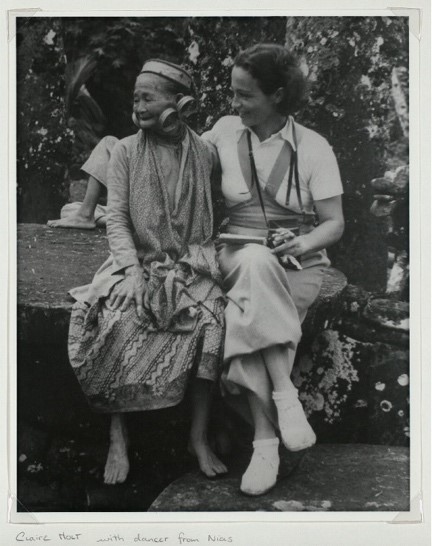
Three personalities: Louis Charles Damais, Claire Holt, Étiennette Bénichou
Claire Holt, portraitist of Indonesian art, 1955-1957
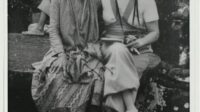
Born Claire Bagg in 1901 in Riga, Latvia, to an upper middle class Jewish family, World War I forced her family to emigrate to Moscow. In 1921, she immigrate to New York where she began a career as a journalist and dance critic (her articles are now signed Claire Holt). In 1930, she goes with her best friend for a trip around the world, the first stop was in the Dutch East Indies, first in Bali and then in Java, where she had a revelation:
« When I saw for the first time a dance performance at a temple feast on Bali I said to myself « here at last is the living dance. » When I saw a Javanese dance-drama performed at the court of H.H. Mangkunegara VII in Solo I gasped into realization that here was a style uncompromising, effective, and magnificent.[1] »
Forgetting about her trip, Holt will live in Java for more than nine years to deepen her knowledge of Javanese dances. In 1936, she began to give lecture-demonstrations on traditional dance, accompanied by choreographic excerpts that she performed herself. These lectures were soon very successful and were presented all over the world. In 1938, Holt spent four months systematically studying, recording, photographing and collecting a great deal of information on the city, village and aristocratic dances of the archipelago.
World War II forced Holt to stay in the United States where she taught Malay at the State Department. Sixteen years after her departure, Holt returned to the archipelago on a grant to study the “historical role of the arts in relation to social and cultural change in Indonesia”.
Upon her return to the United States in 1957 and for more than ten years, she helped form and structure a centre for the study of modern Indonesia within the Centre for Southeast Asian Studies at the prestigious Cornell University in Ithaca, New York. Claire Holt died on May 29, 1970 in Ithaca at the age of sixty-eight.
***
In her proposal to the Rockefeller Foundation and Cornell University, Holt describe her project:
- “to collect data on the nature, form and function of arts such as painting, sculpture, theatre and dance in contemporary Indonesia; to present and interpret the data with reference to the historical role of these arts in the area and with reference to the cross-currents of contemporary social and cultural change.”
To this research project she also add a long term cultural exchange program that will enable new forms of transnational solidarity:
- “All sorts of scholarship and cultural exchange programs now enable Indonesian artists to visit and study abroad (including the Netherlands, France and the United States) on a larger scale than was ever possible before the war.”
Her twenty-month stay of research and data collection on the field will be followed by sixteen months of analysis at Cornell University. Throughout her stay, from 1955 to 1957, it seemed to Holt that she was discovering a new country. She spent a lot of time with Hendra Gunawan, Effendi, Sudjoyono, etc., and from her numerous encounters with a new generation of artists eager for freedom and democracy in the spirit of the just-concluded Bandung Conference, she drew Art in Indonesia: Continuities and Change (Cornell University Press, 1967), a major work that is still a reference.
The book is divided in three parts: first the Heritage which mostly focus on archaeology and where the influences of W.F. Stutterheim (Dutch epigraphist with whom she had a romantic relation in the 30’s as well as Damais’ mentor) are the strongest. Living Traditions focus on performing arts (Dance/Wayang) as well as Bali’s aesthetic and art forms ; and finally Modern Art, where for the first time Holt conduct a direct investigation into the field, interviewing many young artists, critics, and collectors, which constitute till today a precise snapshot of Indonesian Arts around the year 55.
Coming back to USA, Holt will tirelessly work on the second part of her initial proposal as apart of teaching, she launched an exchange program with Indonesia in order to organize exhibitions, invite Indonesian troupes for performances, translate Indonesian writers, write articles, and invite a large number of Indonesian artists to the United States, including Umar Kayam, Selo Sumardjan, Irwan Tirta, But Mochtar, Srihadi Sudarsono, Affandi, and many others. In 1965, she established the Cornell Modern Indonesia Project, which brings together studies on contemporary Indonesia and translations of books and documents on Indonesia’s socio-political development in the 20th century. Her colleagues and students include such leading scholars of the archipelago as Benedict Anderson, Harry J. Benda, Frederick Bunnell, Herbert Feith, Daniel Lev, and James Siegel.
Bersambung…