
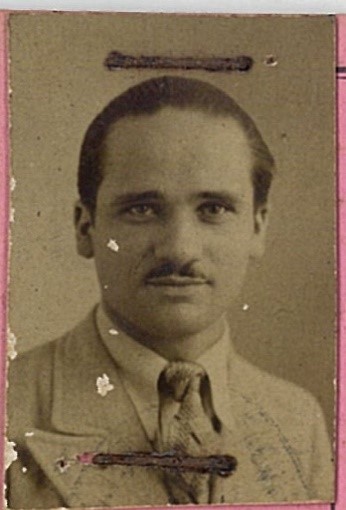
Three personalities: Louis Charles Damais, Claire Holt, Étiennette Bénichou
Louis Charles Damais, the “Enlighted’ orientalist
Born in Paris in 1911, into a family of simple origin, Damais was at a very young age fascinated by languages, living or extinct. A self-taught polyglot, his gift allowed him to enter the prestigious École Nationale des Langues Orientales (National School for Oriental Languages) in Paris where he acquired his knowledge of Oriental languages, from Arabic to Chinese, all through Sanskrit, Malay and ancient Javanese as well as most of the spoken languages in Europe.
With the help of his teachers who saw in him as a brilliant researcher, he obtained a scholarship to continue his studies in Leiden (Netherlands). There he studied for two years and became was close to early Indonesian nationalists among which Dr Prijono (1905-1969). In 1937, Damais obtained a mission to come to Java to learn Malay, Javanese as well as music and gamelan. He studied first in Solo, then moved to Batavia, working for the French Consulate before joining the Dutch archaeological department in Batavia as assistant to the Dutch epigraphist W.F. Stutterheim, who was impressed by his linguistic abilities and knowledge.
Married in 1942 to Raden Soejatoen Arief Poespokoesoemo, father of three children, Damais managed to survive the war and the Japanese occupation in Batavia. Shortly after Indonesia’s independence, he left with his family to teach in a college in Vietnam before joining the prestigious École Française d’Extrême Orient (French School of Asian Studies). He returned to Indonesia in 1951 to inaugurate the first office of this institution in Jakarta where he undertook and published most of his work on Indonesian epigraphy, taught young Indonesian archaeologists, and also translated into French Indonesian literary works such as the letters of Raden Adjeng Kartini or contemporary poetry. Damais died in 1966, at the age of 55, and was buried in Jakarta.
***
Because of his linguistic abilities, his interests, his training, the discipline he practiced until his death, Damais is in the direct line with « Anyone who teaches, writes about, or researches the Orient— and this applies whether the person is an anthropologist, sociologist, historian, or philologist— either in its specific or its general aspects, is an Orientalist, and what he or she does is Orientalism.” (Said, 1979, 2). As a scholar, a researcher, a writer, in his discipline, epigraphy, Damais manifested coherent and strongly bounded area of social knowledge, a system of statements by which Orient could be known and understood: a discourse of orientalism.
But in his private sphere, it was something quite different. As soon as Damais arrived in Dutch Indies he had to face the reality of colonization:
“When I arrived in Java in 1937, I soon had friction with the Dutch – despite correct external relations – because I took no account of the “prestige” that the Whites seem to consider indispensable in the colonies and because I had more friends in Indonesian circles than in European ones. This period gave me the most absolute conviction that a colony, even a “perfectly administered” one, creates situations that are unjustifiable from every point of view. The various reasons put forward to defend colonial systems: economic interests, raw materials, differences in the degree of assimilation of European culture, not to mention the all-too-famous “historical right” etc., all these questions should and could, in my opinion, be resolved in another way if each country wanted to do its part.” (Letter to the Secretary General of the United Nations, 1946).
Damais manifested harsh criticism not only toward Dutch system of colonialism but he also expressed openly anti-colonialism opinions in general. One the reasons might be that Damais was close to “spiritualist” and humanistic movements in the 30’s like the international Theosophical Society which was also very popular in Indonesia among early nationalists, as well as some esoteric milieu in France.
Apart of his private diary which remains unpublished and is the topic of my master, Damais wrote a series of fascinating letters to Claire Holt between 1945 and 1947. In these letters Damais describe numerous events related to the post declaration of Independence and the atmosphere in Batavia at that time. This correspondence, soon to be published, shows also that Damais was not only an observer but he also contributed in some ways to a better comprehension between ex-colonizers and the actors of newly independent country :
« … if I was anti-Dutch, I would not have given an opportunity to the Dutch to meet Indonesians at my house, what I have been doing since about November every week, in order that the Indonesians see that there are also – even if they are only a few – progressive Dutchmen who don’t want to fight to restore the old order, but want to understand the Indonesians point of view. In the beginning few people came. Now I have most of the time 15 to 20 people. Of course I never hide my feelings and everybody who comes can hear after five minutes I’m against any kind of colonial situation. It is probably a crime in this brave new world! » Letter 28-31 May 1946.
Bersambung…